
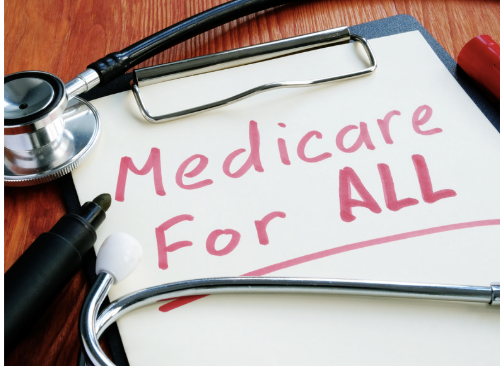

Imagine a seamless, coordinated health care system that would be possible with national health insurance like that
proposed by advocates of Medicare for All. Then think about what has transpired in our country since the pandemic
began. Might we have fared better? Been more prepared? More cohesive as a people?
Clearly, we have witnessed the failure of the Trump administration to lead a coordinated, national, science-based, public
health response to the pandemic. A state-by-state approach proved a disaster as wave after wave of virus spread to every
corner of nation. The virus, if you will, trumped states’ rights. Pun intended.
This commentary, however, asks the question: What if a Medicare for All insurance system had been in place long before
the pandemic and before the Trump administration? For example, no one would have lost their health insurance, no
hospital would have lacked personal protective equipment (PPE), there would be no shortage of nurses or doctors, no
bills piling up on kitchen tables, no medical bankruptcies and no co-insurance payments.
Instead of efficiency, an expensive bureaucracy
Instead of the efficiency inherent in a national health insurance program we have expensive marketing, administrative
and billing bureaucracies of the private insurers that in turn impose administrative burdens on hospitals and medical
providers. A bureaucracy that delivers no health care, but eats up an estimated 32 percent of every health care premium
dollar. Medicare’s administrative costs average about 2 percent.
Such an administrative savings means the nation could cover everyone and expand Medicare to include dental and eye
coverage without additional overall funding. The tens of thousands now working in private insurance and billing
departments could be trained as health care providers or for other productive work.
An egregious example of the failure of our for-profit, privatized health care and insurance system is the recent need to
require nursing home staff that test positive for COVID, but who are asymptomatic, to perform their work. The choice
forced on an already understaffed system is between exposing patients and having enough staff to care for them. How
could we let this happen in our nation?
President-elect Joe Biden repeatedly mentions his determination to help our nation heal. I suggest that the most concrete
measure he could take is to alter his opposition to national health insurance and lend his years of political experience to
advancing Medicare for All. This is a time like no other since that of President Franklin Roosevelt’s for transformative
leadership. As such, Biden has a chance to guide the nation, as did FDR, along a path that leads to a more just and fair
economic future.
Inadequate economic support
Adding to the health insurance crisis is our government’s inadequate economic support in response to the pandemic.
What if the U.S. had a system like that in Europe, where as much as 80 percent of payroll has been covered for anyone laid
off due to actions taken to stem the pandemic? Rent and mortgages could be paid, businesses, large and small, affected by
the pandemic could have retained their employees on payroll. Independent contractors and freelance workers could be
included. Instead of a pink slip, employees would have continued to receive a payroll check. This too is a more efficient
means to distribute economic support.
Two friends of mine in Norway have had no work since March because of the pandemic as they provide services for the
entertainment and convention industry. Both are independent contractors. They have no worries about making mortgage
payments as they receive 80 percent of their incomes. They have no worries about health care, as everyone, including
non-citizens, receive health care. If someone becomes ill they need not choose between working and quarantine.